
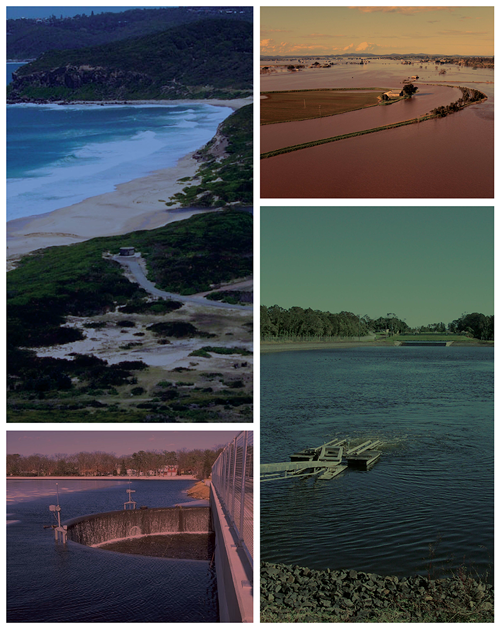


Steve Perrens has kindly allowed us to post PDF copies of his slides as there was a lot of interest.
Latest Blog Posts / Page 15
The Engineers Australia, Sydney Division Water Engineering Panel is pleased to announce that the June presentation is titled Water and Mining and will be jointly given by Dr Steve Perrens and Mr Steve Pells.
Date: 26th June 2013
Time: 5:30 for 6pm
Location: EA Chatswood, 8 Thomas Street
Entry is Free
Refreshments will be provided
A printable PDF flyer is available
Abstract: Mining and unconventional gas developments are intrinsically linked with the production and use of water. The impacts of mining on both surface and groundwater resources are a topical and controversial issue for government and industry alike.
Dr Steve Perrens of Evans & Peck is an experienced environmental engineer who has been involved in water resource management issues for many years. His experience in assisting mines to manage surface water covers most commodities including bauxite, coal, metalliferous and uranium mines.
Dr Perrens will present on the challenges associated with managing surface water in open cut mining operations. He will review the current regulatory context, uncertainties in the assessment of water demands and the effect of climate variability, all of which need to be taken into account in managing surface water on typical open-cut mine sites.
Mr Steven Pells of Pells Consulting is a civil engineer who has practiced over the last 15 years in the fields of hydrology, hydrogeology, hydraulics and geotechnical engineering. Consulting to various longwall mining proponents in the Sydney Basin has led to an active research interest in the impacts of underground mining and coal seam gas extraction on groundwater systems. Mr Pells will present on the impacts of longwall mining and coal seam gas extraction on groundwater regimes in the Sydney Basin.
Just a quick reminder that the call for abstracts for the 35th Hydrology and Water Resources Symposium close on the 14th June 2014. If you are interested in submitting a paper please check out their site for full details.
Project Updates
Monte Carlo Discussion Paper
Monte Carlo simulation offers an alternative to the design event method. This approach recognises that any design flood characteristics (e.g. peakflow) could result from a variety of combinations of flood producing factors, rather than from a single combination. The approach mimics “mother nature” in that the influence of all probability distributed inputs are explicitly considered, thereby providing a more realistic representation of the flood generation processes.
This report describes the practical implementation of Monte-Carlo techniques for flood estimation. The discussion focuses on the manner in which the current (ARR) guidelines and available design information can be used to take into account the natural variability of the inputs, and presents the concepts in a manner that can be implemented in a spreadsheet. While it would be possible to directly employ these techniques with existing models, this guidance should also be found helpful to those using Monte Carlo frameworks that are available in the public domain. The report can be downloaded here.
ARR Update Presentation
ARR editor Professor James Ball is giving a general update on the ARR revision progress at Engineers Australia in Newcastle. Presented will be advice on the document, the progress towards completion and the many changes to practice that will arise from its publication. It will be held in Newcastle on the 3rd of July at 6pm. Further details can be found here.
ARR presentations at the FMA Conference
There will be three presentations directly related to the ARR revision:
- The Revised Intensity-Frequency-Duration (IFD) Design Rainfall for Australia, Janice Green (BoM) on the Thursday at 10.50am
- Estimation of Design Floods Using Continuous Simulation, James Ball (UTS and ARR editor) on the Thursday at 11.50am
- New Regional Flood Estimation Methos for the Whole of Australia: Overview of Progress, Ataur Rahman (UWS) on the Thursday at 1.10pm
For more information on the conference please refer to the website.
General Updates
Call for Reviewers
Those interested in officially reviewing projects should email arr_admin@arr.org.au briefly describing which projects they are interested in reviewing and what qualifications/experience they have in those practice areas. Please include a brief CV. Those wishing to review project reports in an unofficial capacity can download project reports from the website and email comments to arr_admin@arr.org.au.
Australian Rainfall and Runoff has joined LinkedIn. Join the group for discussions and updates on the revision of Australian Rainfall and Runoff.
The following is an advertisment for the upcoming EEA Stormwater Management course:
A 2-day Workshop entitled “Stormwater Management (source control)” will be presented in Sydney on Thursday/Friday 27/28 June, 2013. The Notes provided in the course are based on the content of the award-winning manual “WSUD: basic procedures for ‘source control’ of stormwater – a Handbook for Australian practice” edited by Professor John Argue AO (University of South Australia). This document is endorsed by Stormwater Industry Association (SIA), Australian Water Association (AWA) and by Department of Water, Western Australia. The Notes have been updated, most recently in February, 2013.
Serious issues of stormwater management in Australia are posed by the prospect of 35 million population of Australia by 2050.
- How will Sydney’s existing stormwater infrastructure and that of other major population centres such as Wollongong and Newcastle cope with change under the ‘high density’ option being suggested as a possible re-development scenario ?
- What strategies can be adopted to enable existing (competently-performing) infrastructure to manage these changes without expensive upgrade?
- How can re-development in catchments with existing under-performing stormwater infrastructure be managed to enable the existing in-ground works to progressively meet greater demand without expensive upgrade?
- Must the creeks and natural waterways falling within the jurisdictions of metropolitan and regional population centres such as Western Sydney and the Blue Mountains be sacrificed to hard-lining in the wake of the proposed expansion?
Positive answers to these and many other questions based on WSUD (quantity) ‘source control’ practice will be provided in the Workshop.
The Workshop will also include results of hydrological modelling of high-performing filter bio retention systems enhanced by treatment taking place in parent soil masses; the fate of dissolved pollutants is singled out for particular attention.
The short course includes: design procedures based on state-of-the-art analyses and best overseas practices adapted to Australia-wide conditions; case study illustrations drawn from field installations with between 10 and 18 years of Australian operational history; design ‘worked examples’; introduction and access to rainwater tank sizing software applicable across Australia. An understanding of basic engineering hydrology will be assumed. An optional, overnight homework exercise (requiring use of a calculator) will be included. The Workshop will be conducted as a joint presentation by Professor John Argue and Mr Peter Newland who will take over as sole Presenter of the Workshops in 2014 and beyond.
Why you should attend the Workshop:
- It is offered only once per year in each of the major population centres;
- It covers the three domains of WSUD practice – quantity (urban flooding), quality (pollution treatment/control) and stormwater harvesting – in a comprehensive, integrated manner;
- It provides cost-effective strategies for managing re-development with the potential (already proven) for avoiding hundreds of millions of $ in conventional infrastructure upgrade costs;
- It earns participants 32 hours of CPD credit with Engineers Australia.
More information about the workshop including course content, cost and Registration Forms is available on the EEA website http://www.eeaust.com.au/ or by calling Anna on (03) 9274 9600.
Project Updates
Areal Reduction Factors (ARF)
Due to a lack of adequate research carried out in Australia to derive ARF for use in the different parts of the country, “Australian Rainfall and Runoff” (ARR87, IEAust, 1987) recommended the set of curves derived from a study in the Chicago area for all Australian zones except for the dry inland area of Zone 5 (Figures 2.6 and 3.2 in ARR87). These ARF values apply to design rainfalls for any average recurrence interval (ARI) up to 100 years. The ARFs obtained from a study in the Arizona area, a semi-arid part in the United States, were recommended for use in Zone 5 (Figure 2.7 in ARR87).
There has since been a concern in some sections of the Australian hydrological community that the results from the United States may not be appropriate for the Australian conditions. This concern was confirmed by a number of studies (Nittim, 1989; Avery, 1991; Porter and Ladson, 1993; Masters, 1993; Masters and Irish, 1994; Meynink and Brady, 1993) in which the authors found that the values from ARR87 were generally larger than those from their own study. Moreover, studies in the United Kingdom (Bell, 1976; Stewart, 1989) have conclusively shown that ARFs for that region are dependent on the annual exceedance probability (AEP) of the rainfall. The above established the development of ARFs appropriate to Australia as a high priority research area in flood estimation.
This report provides a summary of ARF assessments around Australia that are recommended for current use in design practice. It also provides a list of recommendations for future research work to further reduce any potential uncertainty in design flood estimates introduced due to uncertainties in the ARF. The report can be downloaded here.
Two Dimensional Modelling
Darwin
Mark Babister, the editor of Project 15, will be giving a presentation on the 23rd of May in the Engineers Australia office in Darwin. This seminar will provide details on the Australian Rainfall & Runoff Update. The session will include Project 5 software demonstration and a presentation on Project 15 – Hydraulic Modelling. Flyer can be downloaded here.
Perth
Andrew McCowan and Mark Babister are running a half day workshop on the recently completed ARR project 15 two dimensional Modelling on Monday the 13th of May. This will be followed by an update on the ARR revision progress. The presentation will also cover the test catchments program which is aimed at testing and validating new methods. Sample catchments in each state/territory will be used and tested with these new methods. Workshop flyer can be downloaded here and the presentation flyer here.
ARR Update Presentation
ARR editor Professor James Ball will be giving a presentation on the status of the ARR update at the Engineers Australia Regional Convention in Port Macquarie. Presented will be advice on the document, the progress towards completion and the many changes to practice that will arise from its publication. The convention runs from the 24th to the 26th of May. Flyer can be downloaded here.
General Updates
Call for Reviewers
Those interested in officially reviewing projects should email arr_admin@arr.org.au briefly describing which projects they are interested in reviewing and what qualifications/experience they have in those practice areas. Please include a brief CV. Those wishing to review project reports in an unofficial capacity can download project reports from the website and email comments to arr_admin@arr.org.au.
Australian Rainfall and Runoff has joined LinkedIn. Join the group for discussions and updates on the revision of Australian Rainfall and Runoff.
The call for papers has now been announced for the 35th Hydrology and Water Resources Symposium. Full details are available on their website.
Project Updates
Project 6 – Loss Models for Catchment Simulation- Rural Catchments
The Stage 2 report on Loss Models for Catchment Simulations – Rural Catchments is being released for industry comment. It involves a pilot study on a limited number of catchments that trials potential loss models to test whether they are suited for parameterisation and application to design flood estimation for ungauged catchments . A range of conceptual loss models were considered for application to rural catchments and the following 4 models are considered most suited for further development for design flood estimation in Australia:
- Initial loss – constant continuing loss
- Initial loss – constant proportional loss
- Initial loss – variable continuing loss
- Probability distributed storage capacity loss model
The careful extension of the study to a larger number of catchments should provide the best opportunity to link the derived loss values to catchment characteristics; a link that has in the past proven elusive. Download Report
Project 1.3 Stage 3 – Rainfall Intensity-Frequency-Duration (IFD) Relationships under Climate Change
Human-induced climate change has the potential to alter the prevalence and severity of rainfall extremes, storm surge and floods. Recognition of the risks associated with climate change is required for better planning of new infrastructure and mitigating potential damage to existing infrastructure.As part of stage 3 funding for the Climate Change component of Project 1 was received (over 1 million dollars). The project official started with an inception meeting last month between the project team including CSIRO, BoM, University of Adelaide, and UNSW.
The goals of the project are to:
- Quantify possible changes and uncertainties in rainfall intensity-frequency-duration (IFD) curves due to anthropogenic climate change.
- Provide interim advice to practitioners on how these changes can be included into design and planning decisions.
In this project, the main objective will be to provide interim advice to practitioners on how possible changes in the magnitude and uncertainty of rainfall IFD under anthropogenic climate change can be incorporated into design and planning. In order to estimate these potential changes, IFD curves for the current climate will be compared to IFD curves estimated for a future climate. Current IFD curves will be generated using different regional climate models and alternative statistical methods, and they will be benchmarked against the IFD curves currently being prepared by the BoM as the baseline.. Any differences between the generated IFD curves and those prepared by the BoM will be investigated for systematic errors and, if there are biases, the generated IFDs will be corrected to be equivalent to the AR&R IFDs.
The project will also include two sub-components that will focus on (a) assessing whether sub-daily rainfall in the study region is non-stationary and (b) using a combination of station and radar data to evaluate the how well dynamically downscaled output reproduces the spatial extent of observed rainfall extremes.
The project will focus on the greater sydney region due to availability of data. A future stage will focus on South East Queensland.
Report Review Process-
The Revision team is committed to producing a quality project for industry. As part of the revision process has been developed where reports are reviewed by the Technical Committee as well as Australian and International reviewers. The following reports are undergoing the detailed review process prior to release to the industry for comment and are expected to be released soon.
-Project 2 – Collation and Review of Areal Reduction Factors from Applications of the CRC-FORGE Method in Australia
General Updates
Call for Reviewers
Those interested in reviewing projects should email arr_admin@arr.org.au or review@arr.org.au briefly describing which projects they are interested in reviewing and what qualifications/experience they have in those practice areas (please include a brief CV).
Australian Rainfall and Runoff has joined LinkedIn. Join the group for discussions and updates on the revision of Australian Rainfall and Runoff.
Project Updates
Project 11
The Stage 2 report on Blockage of Hydraulic Structures has been released for industry comment. Hydraulic blockages can occur within a variety of structures including stormwater inlets and pipes, cross drainage structures, especially culverts and bridges, overland flow paths, drainage channels and waterways, dams and weirs. The principal areas of interest within this report are culverts and bridges as cross drainage structures and the inlets and pipes of urban drainage systems. The issues addressed within this report include:
- Design of drainage systems
- Evaluation of the performance of existing systems
- Management of blockage
Blockage has been identified as an important aspect of drainage planning and design, but one that is little understood and often poorly managed. Blockage can have significant impacts on the drainage system and can lead to costly and sometimes dangerous impacts on the community. This report has followed on from Stage 1 of the project and has indicated recommended design guidance for the incorporation of blockage into the planning, design and management of drainage systems. Download Report
Project 6 and 7 – Losses and Baseflow
The Queensland Water Panel is giving a presentation on Projects 6 and 7 of the ARR revision. This seminar will cover the outcomes from:
Losses
The lack of guidance on design losses has long been regarded as one of the greatest weaknesses in the current edition of ARR. A pilot study has been completed involving 10 catchments (3 from Qld) which will inform the conceptual loss models and approach to be applied to a wider data set, which will ultimately underpin the new guidance in ARR.
Baseflows
Baseflow can potentially represent a significant contribution to smaller flood events. The baseflow characteristics were analysed for over 30,000 flood events from 230 catchments. Regional prediction equations have been developed to enable the estimation of baseflow for ungauged catchments across Australia and guidance provided on how to incorporate baseflow in design flood estimates.
The details are
Venue: Hawken Auditorium, Engineering House, 447 Upper Edward Street, Brisbane, QLD
Date: Wednesday, 20 February 2013
Time: 11:45am for 12 noon start
Cost: Free for EA Members/Students, $20 for Non-EA members – Light snacks and beverages will be provided
Project 15
Deadline for industry comment on Project 15 (2D modelling) is February 19th. Send you reviews to p15@arr.org.au
Report Review Process
The Revision team is committed to producing a quality project for industry. As part of the revision process has been developed where reports are reviewed by the Technical Committee as well as Australian and International reviewers. The following reports are undergoing the detailed review process prior to release to the industry for comment and are expected to be released soon.
-Project 6 – Losses (Rural component)
General Updates
Call for Reviewers
Those interested in reviewing projects should email arr_admin@arr.org.au or review@arr.org.au briefly describing which projects they are interested in reviewing and what qualifications/experience they have in those practice areas.
Australian Rainfall and Runoff has joined LinkedIn. Join the group for discussions and updates on the revision of Australian Rainfall and Runoff.
Project Updates
-Project 15 (Two dimensional Modelling of Urban and Rural Floodplains)
At the time that the 1987 Edition of Australian Rainfall and Runoff was prepared, the use one-dimensional hydrodynamic models for assessment of flooding in riverine and urban systems was an emerging area with two dimensional models being computationally impractical for real world problems. Since that time the situation has changed considerably with technological advances enabling 2D models to become the tool of choice for most hydraulic flood assessments.
For this reason it is necessary to provide guidance on the use of 2D models as part of the updating of ARR.
This project aims to provide guidance to not just modellers, but to those who commission studies and use model results. This document has been prepared in a collaborative approach by a team of Australian industry experts in the field of two dimensional hydrodynamic modelling. All team members gave their time for free. While the document has been independently peer reviewed it is recognized by the project team that many aspects could be covered in more detail. It is also recognized in two dimensional hydrodynamic modelling that practice and technology can advance very quickly. For this reason the document will be reviewed after a 3 month period of industry comment. It is also recognized that this document will need periodic updating.
The Project 15 report is now available on the ARR webpage for download. Comments should be emailed to p15@arr.org.au
Report Review Process
The Revision team is committed to producing a quality project for industry. As part of the revision process has been developed where reports are reviewed by the Technical Committee as well as Australian and International reviewers. The following reports are undergoing the detailed review process prior to release to the industry for comment and are expected to be released soon.
General Updates
Call for Reviewers –
Those interested in reviewing projects should email arr_admin@arr.org.au briefly describing which projects they are interested in reviewing and what qualifications/experience they have in those practice areas.
Australian Rainfall and Runoff has joined LinkedIn. Join the group for discussions and updates on the revision of Australian Rainfall and Runoff.