
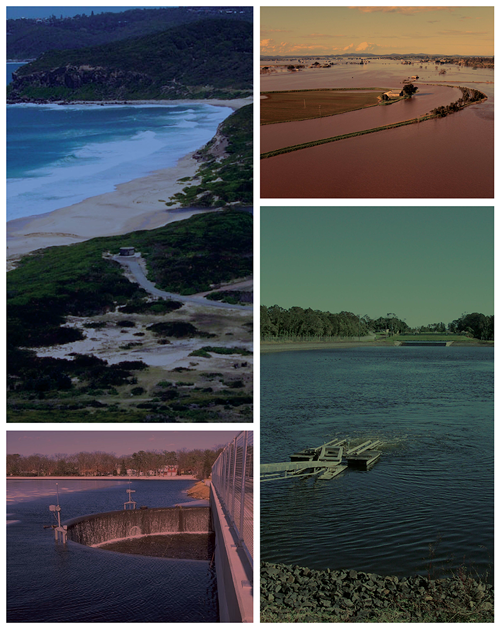


It appears that the State government has started to implement some tools of the information age to catch alleged waterway and restricted area violators. As originally reported by ABC online news.
Latest Blog Posts / Page 22
The EA National Committee on Water Engineering has just announced that the deadline for submitting abstracts for the IAHR2011 and Hydrology Symposium has been extended to 6th August 2010.
The response to the call for abstracts has been very good, however we have received many requests for extensions and as a consequence the deadline has been extended to Friday 6 August 2010.
Short abstracts only are required, maximum 150 words. To submit your abstract electronically, visit www.iahr2011.org and select the “Call for abstracts” option.
Source: EA News Article.
Ian White, Professor of Water Resources and Associate Director Research at ANU, will give the next Sydney Water Engineering Panel session on the impacts of bushfires on the upper Murray-Darling basin. This is scheduled for Tuesday July 27th 2010, 5:30 for 6pm at the EA Auditorium, Chatswood. Refreshments will be available prior to, and during, the event and RSVPs are not necessary.
Professor White’s major research focus is into the interactions of surface water with groundwater systems. His current research activities include the mitigation of land use impacts on catchment yield and water management policy development.
Abstract:
Analysis of the long term impacts of Victoria’s 1939 bushfires on Melbourne’s water supply catchments in the 1970’s revealed startling, long-term decreases in catchment yields as the burnt out mountain ash forests regenerated. It has been suggested that similar decreases in yield would occur in other native-forested water supply catchments in the Murray-Darling Basin. The January 2003 bushfires, which essentially burnt out all of Canberra’s near-pristine Cotter River water supply catchments provided an opportunity to study the impact of severe bushfires on catchments predominantly containing dry sclerophyll forests. This talk will examine the impacts of the 2003 wildfire and a smaller fire in 1983 on water quality and on catchment yield in forests that are different from Victoria’s mountain ash water supply catchments and will discuss reasons for the marked differences in responses. Analysis of results was complicated by the exceptionally dry period following the 2003 bushfires. Additionally, impacts of management decisions on water quality will also be highlighted.
For further details please contact Peter Brady (peter.brady@eng.uts.edu.au) or check out the PDF flyer.

Australian Engineering Week is currently scheduled for the first week of August 2010 and Engineers Australia are in the process of getting publicity out and asking for volunteers. If you are interested please see: www.makeitso.org.au for all the details.
The National Conference Practical Responses to Climate Change is proud to confirm impressive keynote presentations from:
- Dr Jaap Schellekens, Expert Advisor at Deltares, Netherlands
- Dr Kevin Hennessy, Principal Research Scientist at CSIRO Marine and Atmospheric Research, Australia: Climate Change Science Update
- Dr Francis Chiew, Senior Leader at CSIRO Land and Water, Australia: Climate Impact on Water Resources
- Mr John Ginivan, Executive Director – Planning Policy at the Department of Planning and Community Development, Australia: Policy and Pragmatism in the Real World
- Mr Angus Gordon, former CEO of Pittwater Council: Terror Australis – Local Government in Deepening Water
- Mr Rob Skinner, Managing Director, Melbourne Water: Sustainable Cities of the Future
To view the full Conference program and register for the Conference please visit the website www.climatechange2010.org.
Early registration closes on Saturday 3 July 2010
The welcome letter from the congress chair is reproduced here with minor formatting changes:
The 34th Biennial Congress of the International Association for Hydro-Environment Engineering and Research (IAHR) will be held in Brisbane, Australia, 26 June to 1 July, 2011. The Congress theme “Balance and Uncertainty: Water in a Changing World” focuses on the central roles of hydraulic engineering, hydrology and water resources in our changing world and how these roles link to the broader issues. A balance is continually being sought between competing values in water engineering, including the environment, the economy, tourism, social and indigenous values, health aspects, aesthetics, and the needs of current and future generations.
The deadline for abstract submission is the 15 July 2010. Submit your abstract now!
To submit your abstract, visit www.iahr2011.org and select the “Call for abstracts” option. Once A full list of topics and themes is provided and you can quickly lodge your abstract using the on-line submission system. you submit an abstract, you will automatically receive updates. The notification of abstract will be early September and the deadline for full paper will be in October 2010. Each submitted paper will be peer-reviewed.
The congress is jointly organised by IAHR, Engineers Australia and its National Committee on Water Engineering. It will be held in conjunction with Australia’s two premier hydrology and hydraulic conferences:
- the 33rd National Hydrology and Water Resources Symposium and
- the 10th National Conference on Hydraulics in Water Engineering.
The integrated event will be attended by a wide range of international and Australasian academics, researchers, practitioners, regulators, infrastructure developers and resource managers with an interest in water . The congress will include the prestigious IAHR plenary lectures, the Munro and Henderson Orations, the Ippen Award Lecture, and announcements of the GN Alexander Medal recipient and John F Kennedy student award.
The next presentation will be held on 22nd June 2010, 5:30 for 6pm and is titled Wetland Restoration. The venue is the EA Auditorium, Thomas Street, Chatswood and drinks and nibbles will be available in advance.
The presentation will discuss recent successes in coastal wetland restoration and the relevance of this outcome to development offsets via the NSW bio banking initiative http://www.environment.nsw.gov.au/biobanking/. Wetlands are among the most productive ecosystems in the world, yet their extent and health continues to diminish. Australia‟s remaining coastal wetlands are internationally recognized for their unique habitat supporting a range of important local and migratory species. The benefits wetlands contribute are significant. The ecosystem services wetlands provide underpin much of our economic activity and wetlands are recognised as contributing to healthier waterways, fish nursery and habitat areas, drought refuges for stock and wildlife, nutrient capture and recycling, and filtering and capture of sediment. This recognition of the importance of wetlands has led to a concerted effort to restore historical wetland areas to their previous function. This has its challenges as many of these areas have degraded over the years with acid sulphate soils being a specific consideration. Successful rehabilitation has the potential to offset fringe development of other wetland and high conservation areas via the bio banking concept.
A PDF flyer is available for distribution with the full details.
Bill Weeks has sent through a PDF copy of the slides from his recent presentation: Blockage in Drainage Structures.
You will need Adobe Acrobat to read this document.
The next Panel presentation is scheduled for 25th May 5:30 for 6pm and refreshments will be available beforehand. The abstract of the talk is:
This presentation will discuss the ARR Project 11 concerned with blockage. Blockage is an important issue for the design and management of drainage systems, and one that can cause considerable disruption and damage. Blockage can affect bridges and culverts as well as urban stormwater systems. While urban areas are of particular importance, blockage is also a concern in rural regions. Currently available guidelines have some comment but have limited guidance. This project is aimed at improving this situation. The project is being undertaken with the assistance of a committee of experts drawn from different sectors of the industry and different regions of Australia. A workshop in 2009 set the scene and a report was prepared on the issue. The project has continued in 2010 with another workshop and guidelines agreed among the committee. The presentation will describe the process and the conclusions of the project to date.
Full details are available on a PDF Flyer.
ARR Reports Released
The ARR Technical Review team has just released a series of reports and would like feedback, see their email below: