
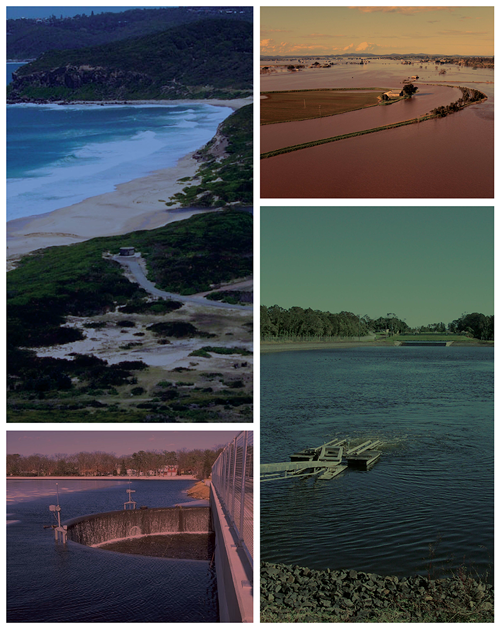


Dr Westra has kindly provided PDF copies of his presentation:
Latest Blog Posts / Page 17
Engineers Australia has just released a discussion paper prompted by the Queensland Flood Enquiry, their notification states:
Engineers Australia has completed a comprehensive analysis of the implications of the Queensland Flood Commission of Inquiry’s Final Report and its recommendations for engineering professionals. Engineers Australia’s report focuses on four key areas concerning flooding and floodplain management including; planning, resilience, response and implementation.
Engineers Australia Queensland Division President Steven Goh highlighted the inconsistent approach to flood plain management across the state as a key issue.
“Engineers Australia has not questioned the technical competence of the engineers involved in the floods. Given the circumstances, the dam operators performed appropriately. Flood operation is a multifaceted task that requires specialised operators who must use their expert technical judgment, with guidance from flood operation manuals or other appropriate documentation,” Goh said.
The full report from Engineers Australia is available online.
Reproduced from Engineers Australia eNews 9 July 2012.
The Water Panel is pleased to announce that the July presentation will be a joint presentation with the NSW Coastal, Ocean and Port Engineering Panel titled: Interaction of Catchment and Coastal Processes on Flooding and Inundation. The presentation will be given in two parts by Seth Westra (UNSW) and Dave Callaghan (UQ).
When: Monday 16th July 2012 – NOTE a different date for us.
Time: 5:30 for 6pm
Where: EA Chatswood
Online registration would be appreciated.
A downloadable PDF of this information is available.
Abstracts
Extremes and extremely big storms: how changing physics impacts statistics in coastal engineering.
While often assumed and applied that extreme event magnitudes can be estimated from measurements, hindsight often offers different outcomes far exceeding our expectations. A recent example involving wave height was seen at Niue where previous “measurements” would have underestimated the risk of wave damage to houses on top of a near vertical cliff 22m above MSL. A polar accelerating tropical cyclone in phase with growing waves (i.e., increasing group celerity) was able to keep the cyclonic winds on the growing waves (typical waves generated by cyclonic winds outrun the wind field, a mechanism that limits their growth). This in phase phenomenon lead to an estimated doubling of wave height compared to that expected for the TC intensity involved. While this is a dramatic version where the more common events look very different to the extreme events, other examples are found for storm surge and wave run- up.
The talk will address how to incorporate these different events into statistical modelling by a simple analytical example that qualitatively explains the empirical shapes found in the NSW storm surge measurements. Some generalisation will be suggested to handle more complex scenarios.
Compound extremes: quantifying interactions between catchment flooding and storm tides in the coastal zone.
Climate and weather related events such as flooding, heatwaves, wildfires and cyclones pose significant risks to society. The overall impact of these events is determined by the interaction of many processes acting together, where the manner in which the processes are combined is often just as important as the state (extreme or otherwise) of each of the driving variables.
This presentation will aim to provide an overarching framework to understand such extremes, focusing on the specific case of coastal flooding as an example of a complex system with many interacting variables. The complexity in such systems arises because floods in estuarine and coastal areas can be caused by both catchment runoff as well as storm tides, and thus both are important in evaluating flood risk. Furthermore, storm surge is largely determined by atmospheric pressure and wind anomalies and thus can be triggered by the same meteorological conditions as intense rainfall events. The diversity of possible interactions which cause such climate extremes suggest that new methods for flood estimation are required that better capture these dependencies, in order to develop more accurate and precise estimates of flood risk.
Speaker Biographies
Dave Callaghan
Before joining the University of Queensland, Dave Callaghan held positions within industry including Parsons Brinckerhoff and Lawson and Treloar and research sector including Nederlands Instituut voor Ecologie and the University of Queensland. He is the author of a book section and more than 50 other technical documents with applied and research applications. He is recognised for leading edge research in coastal engineering including statistics of extremes, beach erosion from extreme events, physical and biological interactions of salt marshes and coral reefs, lagoon dynamics and wave propagation.
Seth Westra
Seth Westra is a Senior Lecturer at the University of Adelaide, and has over eight years of industry and research experience in fields of flood hydrology and hydroclimatology. Seth’s recent research has focused on better understanding the hydrological extremes of flooding and drought under a variable and changing climate, as well as understanding hydrological events which are caused by multiple forcings.
The Water Panel is pleased to announce that the July presentation will be a joint presentation with the NSW Coastal, Ocean and Port Engineering Panel titled: Interaction of Catchment and Coastal Processes on Flooding and Inundation. The presentation will be given in two parts by Seth Westra (UNSW) and Dave Callaghan (UQ).
When: Monday 16th July 2012 – NOTE a different date for us.
Time: 5:30 for 6pm
Where: EA Chatswood
Online registration would be appreciated.
A full printable PDF flyer is to follow shortly.
Project Updates
Project 5 (Regional Flood Methods)
In Australia, there are many streams where there is little/no recorded streamflow data. In these ungauged and poorly gauged catchments, there is insufficient information/data to obtain design flood estimates which are needed to size hydraulic structures, plan and design other water infrastructure and undertake various environmental and ecological studies. Regional flood frequency analysis (RFFA) is the most commonly adopted technique to derive design flood estimates on the ungauged catchments. A RFFA method attempts to transfer flood characteristics information from a group of gauged catchments to an ungauged catchment of interest. The RFFA methods recommended in the Australian Rainfall and Runoff (ARR) in 1987 need updating to reflect the advancements in RFFA methods and new additional streamflow data. find out more here
Project 10 and 15 (People Safety and Flow around buildings)
The final seminar on Flow around buildings and People Safety will be held at the 19th Queensland Water Symposium on 27-28 Sep in Brisbane. A large number of the profession have attended seminars held in Hobart, Perth, Melbourne, Newcastle, Darwin, and Sydney earlier this year.
Report Review Process
The Revision team is committed to producing a quality project for industry. As part of the revision process has been developed where reports are reviewed by the Technical Committee as well as Australian and International reviewers. The following reports are undergoing the detailed review process prior to release to the industry for comment and are expected to be released soon.
Project 4 Continuous rainfall sequences at a Point
Stage 2 report
Project 11 – Blockage of Hydraulic Structures
Stage 2 Report
General Updates
Call for Reviewers
Those interested in reviewing projects should email arr_admin@arr.org.au briefly describing which projects they are interested in reviewing and what qualifications/experience they have in those practice areas.
HWRS 2012
Registration is now open for the Hydrology and Water Resources Symposium. HWRS 2012 is Australia’s largest event devoted to hydrology, water engineering and related areas in water resources management. The Symposium has a long history as Australia’s pre-eminent conference in hydrological research and provides a forum to discuss emergent and innovative approaches for practicing engineers and scientists. HWRS 2012 takes place from 19 – 22 November 2012 at Dockside, Sydney NSW.
HWRS 2012 will bring together a large audience of academics, government officials and industry practitioners. Symposium highlights will include presentations from various researchers working on the 21 Australian Rainfall and Runoff Revision Projects, and keynote speeches from some of the world’s leading experts in hydrology and water resources. Dr Rob Vertessy, of the Bureau of Meterology has been confirmed to give the Munro Oration. Register Here for HWRS 2012!
Australian Rainfall and Runoff has joined LinkedIn. Join the group for discussions and updates on the revision of Australian Rainfall and Runoff.
The August 2012 presentation has just been confirmed for:
Title: Real-Time Quantitative Rainfall Forecasting. Where are We and Where Are We Heading?
Date: August 28th 2012
Time: 5:30pm for 6pm start.
Venue: EA Auditorium, Chatswood
Abstract
Weather prediction and specifically forecasting rainfall in the near term has made significant strides in the last decade. This has largely been due to advances in science and computer power, with several agencies commanding supercomputers in the top 50 in the world. However, rainfall still remains one of the most difficult parameters to forecast even out to 12 hours. The intrinsic problems with forecasting rainfall over other such parameters such as temperature and winds, is its often very chaotic nature both temporally and geographically. Even with global supercomputers modelling at greater resolutions, few are capable of providing the pinpoint accuracy often required by rainfall sensitive industries and projects.
The aim of this talk is to provide an industry-wide overview on current science and forecasting techniques with regard to rainfall, with a special focus on the very latest techniques for trying to improve and correct forecast data provided by the global computer models. The example of the Chatswood Integrated Flood Control and Stormwater Reuse Scheme shall be used as a case study of how such techniques may be applied to vastly enhance rainfall forecasting accuracy. In addition, the talk will touch on how these forecast techniques can be used across the industry as a whole, as well as a quick look into expected future developments.
The Water Panel is pleased to announce the next presentation will be held Tuesday 26th June and discuss the March 2012 Murrumbidgee floods.
Abstract
The March 2012 Murrumbidgee River flood caused inundation of properties from Jugiong to Darlington Point. Wagga and Hay, two major towns protected by levees required evacuation, and in other towns levee upgrade works occurred as the flood wave routed downstream. This presentation explores the situation prior to the flood, looks at flooding consequences and also at the complex operational decisions required to be made by the SES during the event.
Speakers
- Mark Babister – WMAwater
- Peter Cinque – Regional Controller SES
- Steve Gray – WMAwater
Details
- Time: 5:30pm for 6:00pm
- Drinks & nibbles from 5:30pm.
- Venue: Engineers Australia Auditorium, Ground Floor 8 Thomas St, Chatswood NSW 2067
- Enquiries: Mark Babister, babister@wmawater.com.au
Project Updates
A number of ARR projects will be presenting papers on project outcomes at the upcoming Hydrology and Water Resources Symposium (Sydney 19-22nd Nov). For more information visit www.hwrs2012.org.au
Project 10 and 15 (People Safety and Flow around buildings)
The final seminar on Flow around buildings and People Safety will be held at the 19th Queensland Water Symposium on 27-28 Sep in Brisbane. A large number of the profession have attended seminars held in Hobart, Perth, Melbourne, Newcastle, Darwin, and Sydney earlier this year.
Project 18 (Interaction of Coastal and Riverine flooding)
Flooding in the lower reaches of many coastal catchments can result from runoff generated by an extreme precipitation event occurring over the catchment, and/or elevated tail water levels attributable to a combination of high astronomical tide and storm surge. In many cases these flood-producing processes are the result of common meteorological conditions, with elevated storm surges being more likely to occur on days with extreme inland precipitation than on other days. This issue, referred to as joint dependence, can result in higher flood levels compared to the case where these processes are independent. The stage 2 report for Project 18 (Interaction of Coastal and Riverine Flooding) has been released for industry comment and is now available on the ARR webpage. http://www.arr.org.au/Website_links/ARR_Project18_Stage2_Report_Final.pdf
This report presents the outcomes of a pilot study into the application of statistical joint probability methods on extreme rainfall and storm surge in the coastal zone, with a view to providing guidance on the degree of interaction between these two physical process, as well as describing how this information should be applied for the estimation of flood risk along the Australian coastline. As part of this study, three separate areas of work were conducted: (1) the compilation of a large dataset of historical storm tide records at a number of locations along the Australian coastline, which when combined with the existing records of daily and sub-daily rainfall, can form the basis of an empirical study on the joint dependence between these variables; (2) a review of the statistical extreme value modelling literature with the objective of developing a model that can identify the strength of dependence between these variables; and (3) the identification of a methodology by which information on dependence between extreme rainfall and storm surge can be translated to a flood variable (such as a flood level or flow rate) at any location along the Australian coastline.
Report Review Process
The Revision team is committed to producing a quality project for industry. As part of the revision process has been developed where reports are reviewed by the Technical Committee as well as Australian and International reviewers. The following reports are undergoing the detailed review process prior to release to the industry for comment and are expected to be released soon.
- Project 4 – Continuous rainfall sequences at a Point -Stage 2 report – Expected to be released June/July
- Project 5 – Regional Flood Methods Stage 2 Report – Expected to be released June/July
- Project 11 – Blockage of Hydraulic Structures – Stage 2 Report
General Updates
Climate Change
Engineers Australia with the Assistance of BoM and CSIRO have developed their climate change research plan which outlines research necessary to define the impact of climate change on design rainfall, losses, temporal patterns for incorporation into the next edition of ARR and beyond.
Call for Reviewers
Those interested in reviewing projects should email arr_admin@arr.org.au briefly describing which projects they are interested in reviewing and what qualifications/experience they have in those practice areas.
Australian Rainfall and Runoff has joined LinkedIn. Join the group for discussions and updates on the revision of Australian Rainfall and Runoff.
Although not organised by the Panel the presentation came to our attention and may be of interest to our members.
Nanotechnology and Ground Water-‘Small’ Solutions to Big Problems
Presenter: Dr. Denis O’Carroll,
Associate Professor University of Western Ontario, Canada.
Tuesday 5 June at 7pm to celebrate World Environment Day.
Populations in significant parts of Canada and Australia consume groundwater as their domestic water so protection of this resource is essential to their health and well-being. Historically, the subsurface was thought to act as a natural filter of wastes injected into the ground. The potential for these wastes to persist in the subsurface for decades, potentially contaminating drinking water sources was ignored. Non-aqueous phase liquids (NAPLs), such as perchlorethlyene and dichloroethane, are one class of waste liquids that were subject to improper disposal practices. These liquids are extremely difficult to remove from subsurface aquifers and are the focus of this work. Nanometals are one promising innovative groundwater remediation technology that convert these contaminants into less toxic or nontoxic materials. They are particularly useful because of their size – a single human hair is 500 to 5,000 times as wide. At that scale, they can move through microscopic flow channels in soil and rock, reaching and destroying groundwater pollutants that larger particles cannot. In this study reactive nanometals were developed to degrade subsurface contaminants. Nanometals that were developed in our laboratory were injected at two contaminated site in Ontario, Canada. One of these field trials was part of a The Nature of Things with David Suzuki television special focusing on environmental nanotechnology. Significant contaminant degradation has been observed at both of these test sites.
Dr. O’Carroll is an Associate Professor in Civil and Environmental Engineering at the University of Western Ontario and a Senior Visiting Fellow at the University of New South Wales. He completed his Ph.D. at the University of Michigan. Upon completion of his Ph.D. Dr. O’Carroll completed one postdoctoral fellowship at the University of Michigan and was awarded a NSERC postdoctoral award to complete a postdoctoral fellowship at the University of Toronto. He was awarded the Province of Ontario 2007 Early Researcher Award and more recently the University of Western Ontario Green Award and the R. Mohan Mathur Award for Excellence in Teaching. He is an Associate Editor for the Vadose Zone Journal and Special Guest Editor for the Journal of Contaminant Hydrology’s special issue: Manufactured Nanomaterials in Subsurface Systems. He has ongoing research projects developing nanometals for contaminated site remediation, investigating the fate of carbon based nanoparticles in the environment, improving our understanding of the fate of waste liquids in the subsurface as well as green roof performance.
Free event at Manly.
Bookings essential.
Contact: Manly Environment Centre 9976 2842.
The organisers have just posted an announcement for the 4th EGU Leonardo Conference on the Hydrological Cycle, which is reporoduced below.